An Estimated 35% of Everything Amazon Sells Comes From Its Recommendation Engine. The Same Math Works at Your Size.
McKinsey's Next in Personalization research put hard numbers on a soft-sounding idea: companies that excel at personalization generate 40% more revenue from those activities than average players, personalization typically lifts revenue 10–15%, and it can cut customer acquisition costs by up to 50%. The most famous engine of all — Amazon's — is widely estimated to drive 35% of its purchases. Meanwhile 71% of consumers now expect personalized experiences, and 76% get frustrated without them. The technology behind this stopped being an enterprise luxury years ago. Here's what recommendation engines actually earn — and what it takes to run one on a regional store.
By the numbers
The insight
Recommendation engines turn browsing data into revenue by answering one question per visitor: "what is this person most likely to want next?" The economics are established. McKinsey's research across US industries found personalization typically lifts revenue 10–15% (up to 25% depending on sector and execution), improves marketing efficiency 10–30%, and can cut acquisition costs by half — and companies that excel at it generate 40% more revenue from those activities than average players. At the retail frontier, Amazon's engine is widely estimated to drive 35% of purchases (a figure so established it's industry folklore, though Amazon has never published it), Barilliance attributes up to 31% of e-commerce revenue to recommendations in sessions where shoppers engage with them, and engaged sessions show dramatically higher order values. The consumer side closed the argument: 71% expect personalization, 76% are frustrated without it, and 80% are more likely to buy from brands that offer it. What changed recently is access — the algorithms behind "customers also bought" now run on open-source stacks a mid-size regional store can afford.
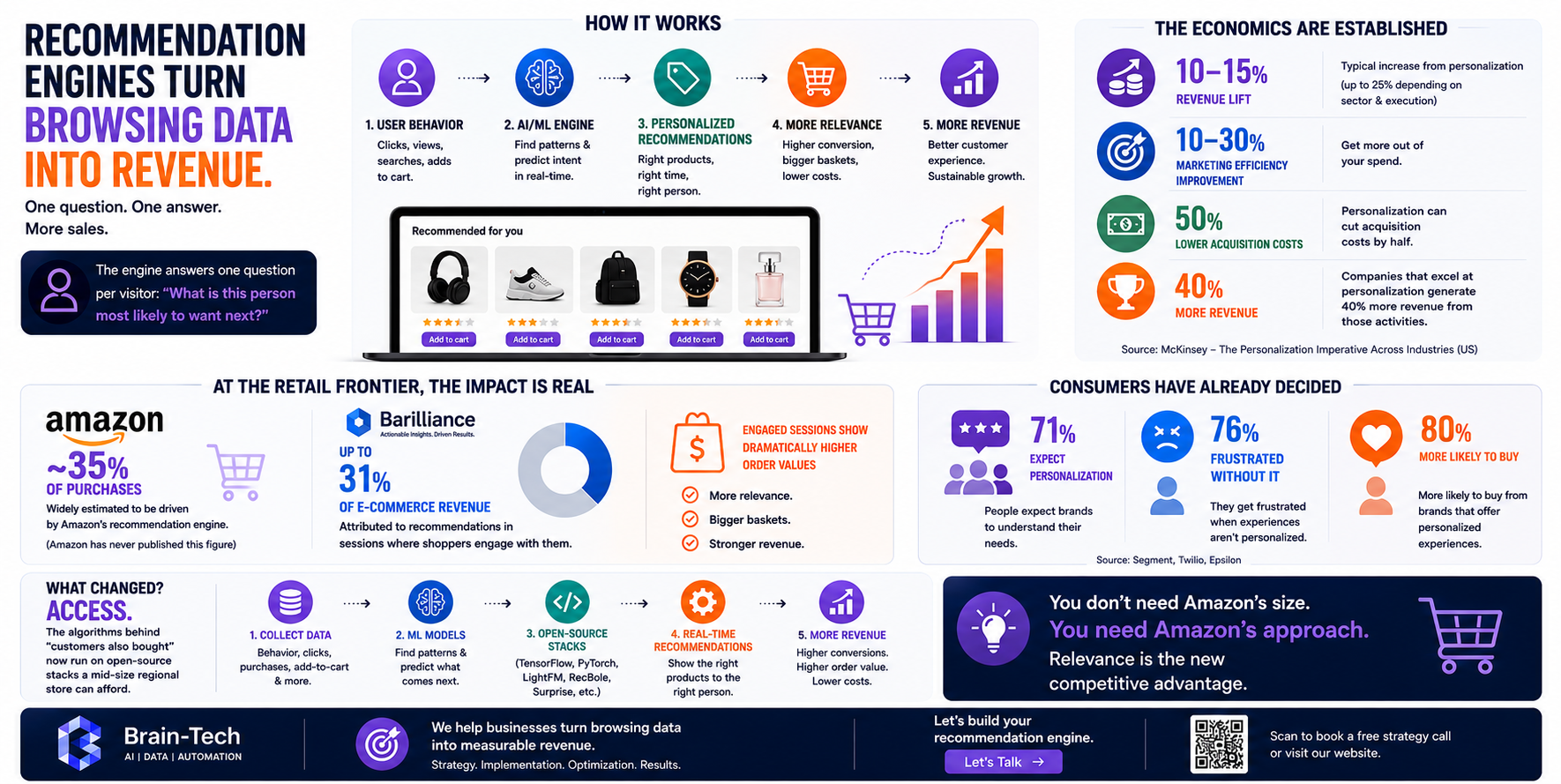
The challenge
Most regional stores treat every visitor identically: the same homepage for the loyal repeat buyer and the first-time browser, the same "related products" that are really just the same category sorted by date, and generic broadcast emails sent to everyone. The research prices this uniformity. If engaged recommendation sessions can carry up to 31% of revenue, a store with zero real recommendations is running without one of e-commerce's largest proven revenue layers. The frustration cost is direct — 76% of consumers are frustrated by non-personalized experiences, and three-quarters switched brands during the pandemic era, proving loyalty won't cover the gap. There's also a data irony: the typical regional store already owns everything an engine needs — order history, browsing paths, product attributes — sitting unused in its database while the owner pays rising ad prices to acquire strangers, when the cheapest revenue (McKinsey's −50% CAC finding) was in serving the customers it already has, better.
Our approach
We build recommendation systems the way the case studies say they succeed: as engineering projects with measured revenue, not plugins installed and forgotten. The sequence: start where attribution is cleanest — email and abandoned-cart flows with personalized product picks, where A/B testing against generic sends proves the lift in weeks. Then move on-site: "frequently bought together" on product pages and a personalized homepage row, powered by algorithms matched to your catalogue size and data volume (collaborative filtering when you have rich order history; content-based and hybrid approaches when catalogues are young — the practical reason our engine library implements five algorithm families rather than one). Feed it the data you already own; no invasive tracking required. Measure one number above all: revenue per session with recommendations engaged versus without. And keep the human rule the research keeps confirming — relevance builds trust, creepiness burns it — so recommendations explain themselves ("because you bought X") and never touch sensitive categories.
Evidence
The research behind this
Excellers generate 40% more revenue from personalization; typical lift 10–15%; 71% expect it, 76% frustrated without it
Read the studyPersonalization can cut acquisition costs up to 50% and lift marketing ROI 10–30%
Read the studyUp to 31% of e-commerce revenue attributable to recommendations in engaged sessions; engaged sessions show sharply higher order values
Read the study~35% of Amazon purchases estimated to come from recommendations — widely cited since a 2013 McKinsey analysis, never officially confirmed by Amazon
Read the studyThe bridge
How Brain-Tech helps you capture this advantage
Recommendations carry up to 31% of revenue in engaged sessions
A store showing everyone the same products is leaving a proven revenue layer switched off
Production-ready recommendation engine (five algorithm families) integrated into your existing store — Laravel, FastAPI, or Django
Personalization can cut customer acquisition costs by up to 50% (McKinsey)
Your cheapest growth is hiding in the order history you already own — not in higher ad budgets
Personalized email & abandoned-cart flows powered by your own purchase data
76% of consumers are frustrated by non-personalized experiences — and switch brands readily
Relevance is now a retention tool: the store that "gets" the customer keeps the customer
Personalized on-site experiences: homepage rows, "bought together", and category ranking tuned per shopper
FAQ
Frequently asked questions
How much revenue do recommendation engines actually drive?
An estimated 35% of Amazon's purchases come from recommendations, and Barilliance attributes up to 31% of e-commerce revenue to them in engaged sessions. McKinsey finds personalization typically lifts total revenue 10–15%, with leaders earning 40% more from it than average players.
Is this technology only for giants like Amazon?
No — the algorithms behind "customers also bought" now run on open-source stacks. A mid-size store's own order history and browsing data are enough to power collaborative and hybrid recommendation models at a fraction of enterprise cost.
What data does a recommendation engine need?
Mostly what your store already stores: order history, product attributes, and browsing behavior. No invasive tracking is required — and transparent recommendations ("because you bought X") convert better than opaque ones anyway.
Where should a store start with personalization?
Email and abandoned-cart flows first — attribution is cleanest there and A/B tests prove the lift within weeks — then on-site recommendations ("frequently bought together", personalized homepage rows), measuring revenue per engaged session throughout.
Put your own data to work selling
Brain-Tech builds production recommendation engines — five algorithm families, integrated into Laravel, FastAPI, or Django stores, measured in revenue per session. Ask us for a free personalization readiness check: we'll review the data your store already collects and show you which recommendation strategy it can power from day one.
Get my free personalization readiness check