A Data Breach in the Middle East Now Costs SAR 27 Million on Average. What's Standing Between One and Your Business?
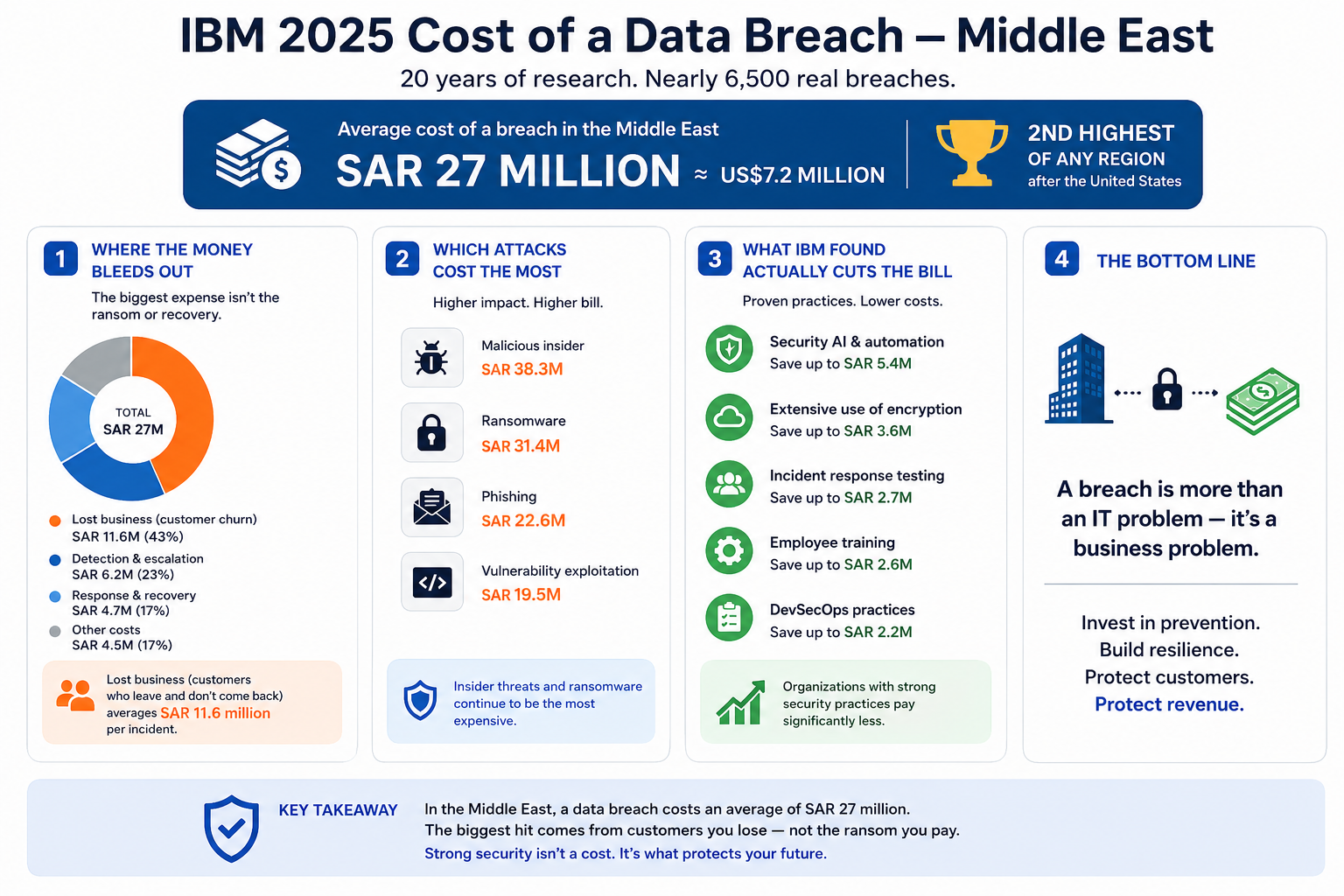
IBM's 2025 Cost of a Data Breach report — twenty years of research covering nearly 6,500 real breaches — puts the average cost of a breach in the Middle East at SAR 27 million (about US$7.2 million), the second-highest of any region in the world after the United States. The single biggest expense isn't the ransom or the recovery: it's lost business — customers who leave and don't come back, averaging SAR 11.6 million per incident. This research breaks down where that money bleeds out, which attacks cost the most, and the specific engineering practices IBM found actually cut the bill.
By the numbers
The insight
IBM and the Ponemon Institute analyzed real breaches at 600+ organizations worldwide — including Saudi Arabia and the UAE — between March 2024 and February 2025. The regional headline: a Middle East breach averages SAR 27 million (~US$7.2M), down 18% from the previous year but still far above the US$4.44 million global average and second only to the United States. The cost anatomy matters more than the total: lost business is the largest slice at SAR 11.6 million, followed by post-breach response (SAR 7.5M), detection and escalation (SAR 6.6M), and notification (SAR 1.3M). By attack vector, third-party and supply-chain compromise leads at 17% of incidents (SAR 29.6M average), phishing and denial-of-service each account for 14%, and malicious insiders — though only 11% of cases — carry the highest price at SAR 33 million. The encouraging finding: the same report identifies exactly what pushed regional costs down 18% — AI/ML-driven security insight, encryption, and a DevSecOps approach — and quantifies the saving from extensive security AI and automation at US$1.9 million per breach.
The challenge
Most SMEs in the region assume breaches are an enterprise problem — until the cost anatomy is read closely. The largest expense, SAR 11.6 million in lost business, is proportionally worse for a smaller company: an enterprise survives reputational damage; an SME whose customer database leaks on a Telegram channel often doesn't. The attack vectors in the regional data are precisely the ones small businesses leave open: phishing (14% of breaches, SAR 28M average) lands on staff with no training; supply-chain compromise (17%, the most common vector) arrives through the plugins, packages, and third-party scripts inside a cheaply built website; and the everyday versions of these attacks — contact-form abuse, credential stuffing, unpatched CMS plugins, exposed admin panels — hit regional SME sites daily. There's also a new cost line: IBM found shadow AI (staff using unapproved AI tools with company data) adds US$670,000 to a breach, and 97% of AI-related breaches happened where access controls were missing. Security is no longer a big-company line item; it's priced into every quotation your business will ever lose after an incident.
Our approach
We translated IBM's cost-reduction findings into an SME-sized security baseline — the same three factors the report credits for the region's 18% cost drop, scaled to businesses without a security team. First, secure-by-build (DevSecOps for the rest of us): security decisions inside the development process, not bolted on after — input validation, rate limiting, hardened authentication, least-privilege access, dependency auditing on every third-party package (the supply-chain vector that leads regional breaches), and automated tests that ship with the code. Second, encryption and access hygiene as defaults: encrypted data at rest and in transit, no shared admin accounts, role-based permissions, and formal offboarding — the direct answer to the SAR 33M insider vector. Third, detection you can afford: logging, uptime and anomaly monitoring, and an incident plan that names who does what in the first hour, because IBM's twenty-year dataset says one thing above all — the cheapest breach is the one contained fastest. None of this requires enterprise budgets; all of it requires the discipline to build it in from day one.
Evidence
The research behind this
SAR 27M average regional breach cost; lost business SAR 11.6M; vectors and sector breakdowns; AI/encryption/DevSecOps behind the 18% drop
Read the studyGlobal average $4.44M; security AI & automation save $1.9M per breach; shadow AI adds $670K; 97% of AI breaches lacked access controls
Read the studySupply-chain compromise 17% of incidents (SAR 29.6M); phishing 14% (SAR 28M); malicious insiders 11% but the costliest at SAR 33M
Read the studyMiddle East at ~$7.29M — the second-highest region worldwide after the US ($10.22M), well above the $4.44M global average
Read the studyThe bridge
How Brain-Tech helps you capture this advantage
Supply-chain compromise is the region's #1 breach vector (17% of incidents, SAR 29.6M average)
Every cheap plugin, unvetted package, and third-party script in your website is a door someone else holds the key to
Secure-by-build web systems: audited dependencies, hardened auth, input validation, and rate limiting as standard
IBM credits DevSecOps, encryption, and AI-driven insight for the region's 18% cost drop
The savings go to businesses whose security is engineered in, not patched on after launch
Security review & hardening for existing sites: form abuse protection, access audit, encryption, and monitoring
Lost business is the largest breach cost — SAR 11.6M in customers who don't come back
Customer trust is the asset actually under attack; uptime and data care are marketing, not just IT
Monitoring, backups, and an incident plan sized for SMEs — so a bad hour never becomes a lost customer base
FAQ
Frequently asked questions
How much does a data breach cost in the Middle East?
SAR 27 million on average (about US$7.2 million) per IBM's 2025 Cost of a Data Breach report — the second-highest of any region worldwide, well above the US$4.44 million global average.
What's the most expensive part of a breach?
Lost business — SAR 11.6 million on average in the region: customers who leave after an incident and revenue that never returns. Response, detection, and notification costs come after.
How do breaches usually start?
In the regional data: third-party and supply-chain compromise leads (17% of incidents), with phishing and denial-of-service at 14% each. Malicious insiders are rarer (11%) but the costliest at SAR 33 million.
Does security have to be expensive for a small business?
No — the practices IBM credits for the region's 18% cost drop (secure development, encryption, monitoring) scale down: audited dependencies, hardened authentication, role-based access, backups, and an incident plan are engineering discipline, not enterprise budget.
Find your open doors before someone else does
Brain-Tech builds and hardens web systems with security engineered in — audited dependencies, protected forms, hardened authentication, encryption, and monitoring, following the same practices IBM's data links to lower breach costs. Ask us for a free security snapshot of your website: we'll check the most common regional attack surfaces and send you a plain-language report of what's exposed.
Get my free security snapshot