$290 Billion in Sales Is Moving Into Chat Apps. Your Customers Are Already on WhatsApp — Is Your Business?
Global conversational commerce — buying and selling inside chat threads — is projected to exceed US$290 billion by 2028. In MENA, the shift is even sharper: WhatsApp penetration exceeds 90% in the UAE, Saudi Arabia, and Egypt, 175 million people worldwide message a business on the app every day, and two thirds of consumers who chat with a business go on to buy. The sale is no longer happening on your website first. It's happening in the chat — and the businesses that answer in seconds, in the customer's language, are the ones getting paid.
By the numbers
The insight
The world's buying conversations have moved into chat apps, and the money is following: conversational-commerce revenues are projected to exceed US$290 billion globally by 2028, with the software market behind it growing from US$12.6 billion in 2026 toward US$22.6 billion (Mordor Intelligence). MENA is one of the most chat-native regions on earth — WhatsApp penetration exceeds 90% in the UAE, Saudi Arabia, and Egypt (Egypt alone has ~56 million users), and 75% of nationals across seven Middle East countries use the app regularly. On the commercial side, the numbers are blunt: over 200 million businesses now use WhatsApp Business, 175 million consumers message a business daily, WhatsApp messages reach open rates of up to 98% versus roughly 20% for email, and about 66% of consumers who start a WhatsApp conversation with a business complete a purchase. This research maps what that means, in revenue, for a MENA business still treating WhatsApp as one employee's phone.
The challenge
Most MENA businesses already use WhatsApp — as one employee's personal phone, answered when someone is free. The research puts a price on that setup. 56% of users abandon a purchase when replies are slow, and expectations are brutal: a majority of consumers expect responses within minutes, with 57% of messages in high-performing setups answered inside the first minute. Every hour a quotation request sits unanswered, a competitor with automated responses is closing that customer. The gaps compound: inquiries arrive in Arabic and English while 72% of consumers say they're more likely to buy when helped in their native language — and 29% of businesses report losing customers for lacking multilingual support. Meanwhile the phone holding the entire customer history walks out the door with the employee every evening: no CRM record, no follow-up system, no way to recover the ~60% of abandoned carts that structured WhatsApp flows recover. The channel with the region's highest open rates is, in most companies, its least managed asset.
Our approach
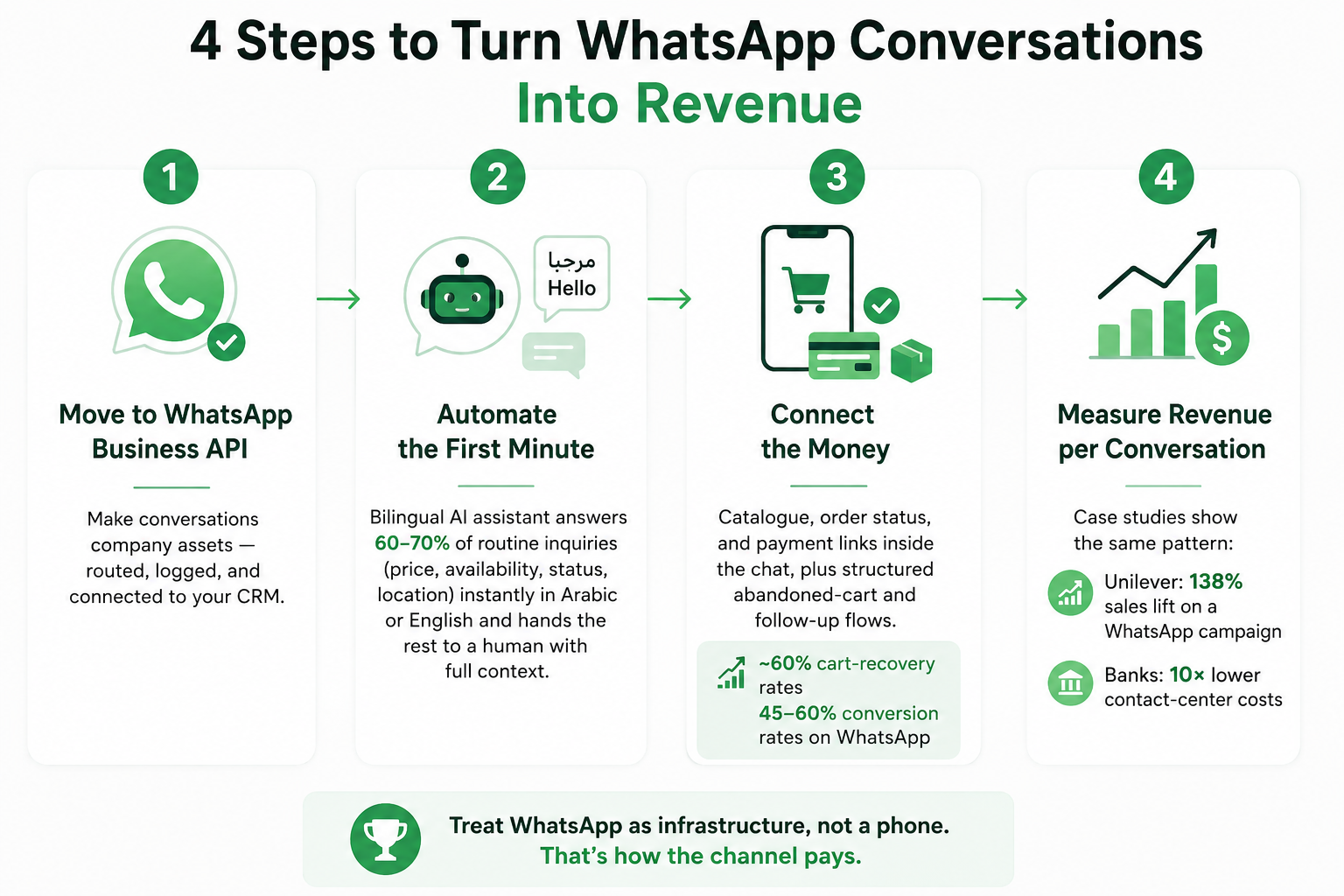
We mapped the conversational-commerce data to a build sequence a regional SME can deploy without enterprise budgets. Step one: move from a personal number to the WhatsApp Business API, so conversations become company assets — routed, logged, and connected to your CRM instead of trapped in one handset. Step two: automate the first minute, because that's where the 56% abandonment happens — a bilingual AI assistant answers the 60–70% of inquiries that are routine (price, availability, status, location) instantly in Arabic or English, and hands the rest to a human with full context. Step three: connect the money — catalogue, order status, and payment links inside the chat, plus structured abandoned-cart and follow-up flows (the mechanism behind WhatsApp's ~60% cart-recovery rates and its 45–60% reported conversion rates, versus single digits for email). Step four: measure revenue per conversation, not message counts. The pattern in every published case study — from Unilever's 138% sales lift on a WhatsApp campaign to banks cutting contact-center costs 10× — is the same: the channel pays when it's treated as infrastructure, not as somebody's phone.
Evidence
The research behind this
Software market growing from $12.6B (2026) to $22.6B; global conversational-commerce revenues projected to exceed $290B by 2028
Read the study3.3B users; MENA the dominant chat region with 90% penetration in the UAE; 175M people message a business daily; 200M+ businesses on the platform
Read the study75% of nationals across seven Middle East countries — including Egypt, Saudi Arabia and the UAE — use WhatsApp regularly; Egypt has ~56M users
Read the studyOpen rates up to 98% vs ~20% email; 66% of business chats end in purchase; ~60% cart recovery; 56% abandon on slow replies; 72% prefer buying in their native language
Read the studyThe bridge
How Brain-Tech helps you capture this advantage
56% of users abandon a purchase when replies are slow; top performers answer within the first minute
Response speed is a revenue variable — every unanswered hour is a competitor's closed deal
Bilingual AI assistants on the WhatsApp Business API, answering routine inquiries in seconds, 24/7
66% of consumers who chat with a business complete a purchase; WhatsApp flows recover ~60% of abandoned carts
The chat thread is a sales funnel — catalogue, payment link, and follow-up belong inside it
WhatsApp commerce integration: catalogue, order status, payment links, and automated cart-recovery flows connected to your store
72% of consumers are likelier to buy when helped in their native language; 29% of businesses have lost customers over missing multilingual support
In a market that messages in Arabic and English interchangeably, single-language support quietly filters out paying customers
Arabic/English conversational AI trained on your actual products, prices, and policies
FAQ
Frequently asked questions
How big is conversational commerce?
Global conversational-commerce revenues are projected to exceed US$290 billion by 2028, with the software market behind it growing from US$12.6 billion in 2026 to US$22.6 billion (Mordor Intelligence). Meta's business-messaging revenue already runs at a US$1 billion annual rate.
Do customers in the Middle East actually buy through WhatsApp?
Yes — WhatsApp penetration exceeds 90% in the UAE, Saudi Arabia, and Egypt, 175 million people worldwide message a business on it daily, and about 66% of consumers who start a business conversation complete a purchase.
What's wrong with running WhatsApp from an employee's phone?
Slow replies cost sales (56% of users abandon a purchase when responses lag), conversation history isn't a company asset, there's no CRM record or follow-up system, and abandoned carts — which structured WhatsApp flows recover at ~60% — are simply lost.
Does a WhatsApp AI assistant need to replace my team?
No — the model that works has AI answering the 60–70% of inquiries that are routine (price, availability, status) instantly in Arabic or English, and handing the rest to your team with full context, so humans spend their time closing deals instead of repeating answers.
Turn your WhatsApp into a sales channel that never sleeps
Brain-Tech builds bilingual WhatsApp sales systems on the official Business API — instant Arabic/English answers, catalogue and payment links in the chat, and automated follow-ups connected to your CRM. Ask us for a free WhatsApp sales audit: we'll review how your inquiries are handled today and show you, in numbers, the orders currently slipping through.
Get my free WhatsApp sales audit