Amazon Loses 1% of Sales for Every 0.1 Seconds of Delay. How Much Is Your Slow Website Costing You?
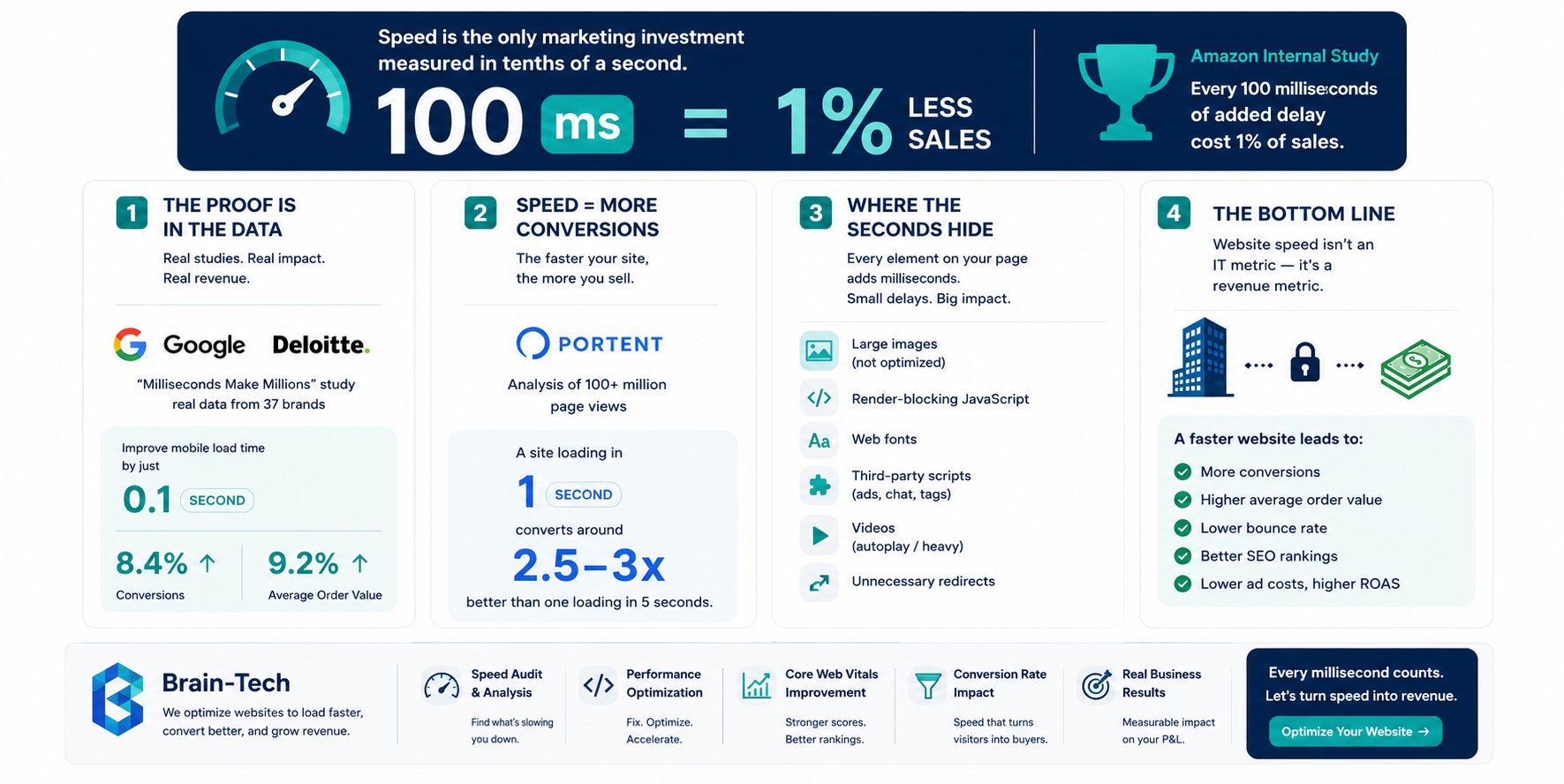
Speed is the only marketing investment measured in tenths of a second. Google and Deloitte's "Milliseconds Make Millions" study — real data from 37 brands — found that improving mobile load time by just 0.1 seconds lifted retail conversions 8.4% and average order value 9.2%. Portent's analysis of 100+ million page views found a site loading in 1 second converts around 2.5–3x better than one loading in 5. Amazon's famous internal test put it bluntly: every 100 milliseconds of added delay cost 1% of sales. Your website's speed isn't a technical score — it's a line in your P&L. Here's the evidence, and where the seconds hide.
By the numbers
The insight
The speed-revenue relationship is among the most replicated findings in web analytics. Deloitte and Google's study of 37 retail, travel, and lead-gen brands isolated speed within the same brands over time and found a 0.1-second mobile improvement lifted retail conversions 8.4%, order value 9.2%, and travel conversions 10.1%. Portent's dataset of 100+ million page views shows conversion falling roughly 4.4% per extra second in the 0–5 second range, with 1-second sites converting about 3x better than 5-second sites. Amazon's internal latency experiment (1% of sales per 100ms) and Walmart's (+2% conversions per second saved) confirm it at scale. The stakes are highest on mobile — 53% of visitors abandon pages slower than 3 seconds — which is exactly where MENA traffic lives: 72% of the region's e-commerce transactions happen on smartphones, often on 4G. Speed also compounds through Google's Core Web Vitals ranking factors: a slow site pays twice, in lost conversions and lost visibility.
The challenge
The trap is that owners test their sites on the wrong device. Your site feels fast on your laptop over office Wi-Fi — but your customer is on a mid-range Android over 4G, where the same page takes 5–8 seconds. Run the honest math: a store doing EGP 5 million a year online at a 5-second mobile load, brought to ~2 seconds, sits in the range where Portent's data shows conversion multiples — hundreds of thousands of pounds of revenue from the same traffic, the same products, the same ad spend. The leaks are always the same: uncompressed hero images, a heavy theme, 8–15 third-party scripts (chat widgets, pixels, sliders) each adding delay, no caching layer, and shared hosting struggling at peak. Every one of those is paid for twice — once in abandoned visitors, once in higher ad costs, because Google's mobile-first index and Quality Score both punish slow pages. Speed is the cheapest conversion optimization most businesses never do.
Our approach
Speed work pays fastest when it follows the revenue path, not the Lighthouse score. Our sequence: measure first on the devices customers actually use (real 4G, mid-range Android — not the office laptop), starting with the pages that make money: home, category, product, checkout. Then fix in impact order: images (WebP/AVIF, correct sizing, preloaded hero — usually half the problem), third-party script audit (every widget must justify its milliseconds), caching and a CDN so repeat loads are near-instant, then server response — where a properly tuned VPS or upgraded hosting often beats months of code tweaks. Target Google's Core Web Vitals thresholds (LCP under 2.5s, INP under 200ms, CLS under 0.1) because they compound into rankings and ad Quality Scores. Then re-measure conversions, not scores: Deloitte's data says every 0.1 second recovered shows up in the revenue line within weeks. Typical optimization for a mid-size store pays for itself in 2–4 months of the resulting uplift.
Evidence
The research behind this
0.1s mobile improvement → +8.4% retail conversions, +9.2% AOV, +10.1% travel conversions — measured within the same 37 brands over time
Read the study1-second sites convert ~3x better than 5-second sites; conversion drops ~4.4% per extra second in the 0–5s range
Read the studyAmazon: 1% of sales lost per 100ms of added delay; Walmart: +2% conversions per second of improvement
Read the study53% of mobile users abandon sites taking over 3 seconds; bounce probability rises 32% from 1s to 3s; Core Web Vitals are ranking factors
Read the studyThe bridge
How Brain-Tech helps you capture this advantage
A 0.1-second improvement lifts retail conversions 8.4% and order value 9.2%
Speed is revenue from traffic you already paid for — no new ads required
Full performance optimization: images, scripts, caching, CDN, Core Web Vitals compliance
53% of mobile visitors abandon pages slower than 3 seconds — and 72% of MENA purchases are mobile
In this region, mobile speed IS the storefront
Mobile-first builds tested on real regional devices and networks, not office laptops
Slow server response caps everything — no front-end fix outruns bad hosting
The right hosting architecture is a conversion decision, not an IT expense
Hosting & server tuning: VPS setup, caching layers, and deployment engineered for speed
FAQ
Frequently asked questions
How much does website speed really affect sales?
Measurably and repeatedly: Google & Deloitte found a 0.1-second improvement lifts retail conversions 8.4% and order value 9.2%; Portent found 1-second sites convert about 3x better than 5-second sites; Amazon measured 1% of sales lost per 100ms of delay.
What speed should my website target?
Google's Core Web Vitals thresholds: main content visible within 2.5 seconds (LCP), interactions responding under 200ms (INP), and layout shift under 0.1 (CLS) — measured on real mobile devices, where 53% of visitors abandon anything over 3 seconds.
Why does my site feel fast to me but customers complain?
You're testing on a laptop over fast Wi-Fi; customers are on mid-range phones over 4G, where the same page can take 5–8 seconds. Always measure on the devices and networks your market actually uses.
Does speed affect my Google ranking and ad costs too?
Yes — Core Web Vitals are ranking factors, and ad platforms' Quality Scores penalize slow landing pages. A slow site pays three times: lost conversions, lower rankings, and higher cost per click.
Find out how many sales your load time is eating
Brain-Tech runs performance engineering the way the research says it pays: measured on real regional devices, fixed in revenue order, verified in conversions. Ask us for a free speed-to-revenue report: we'll test your money pages on real mobile conditions and show you — in seconds and in money — exactly what a faster site would return.
Get my free speed-to-revenue report