AI Automation for MENA Businesses: The $320 Billion Opportunity
By the numbers
The insight
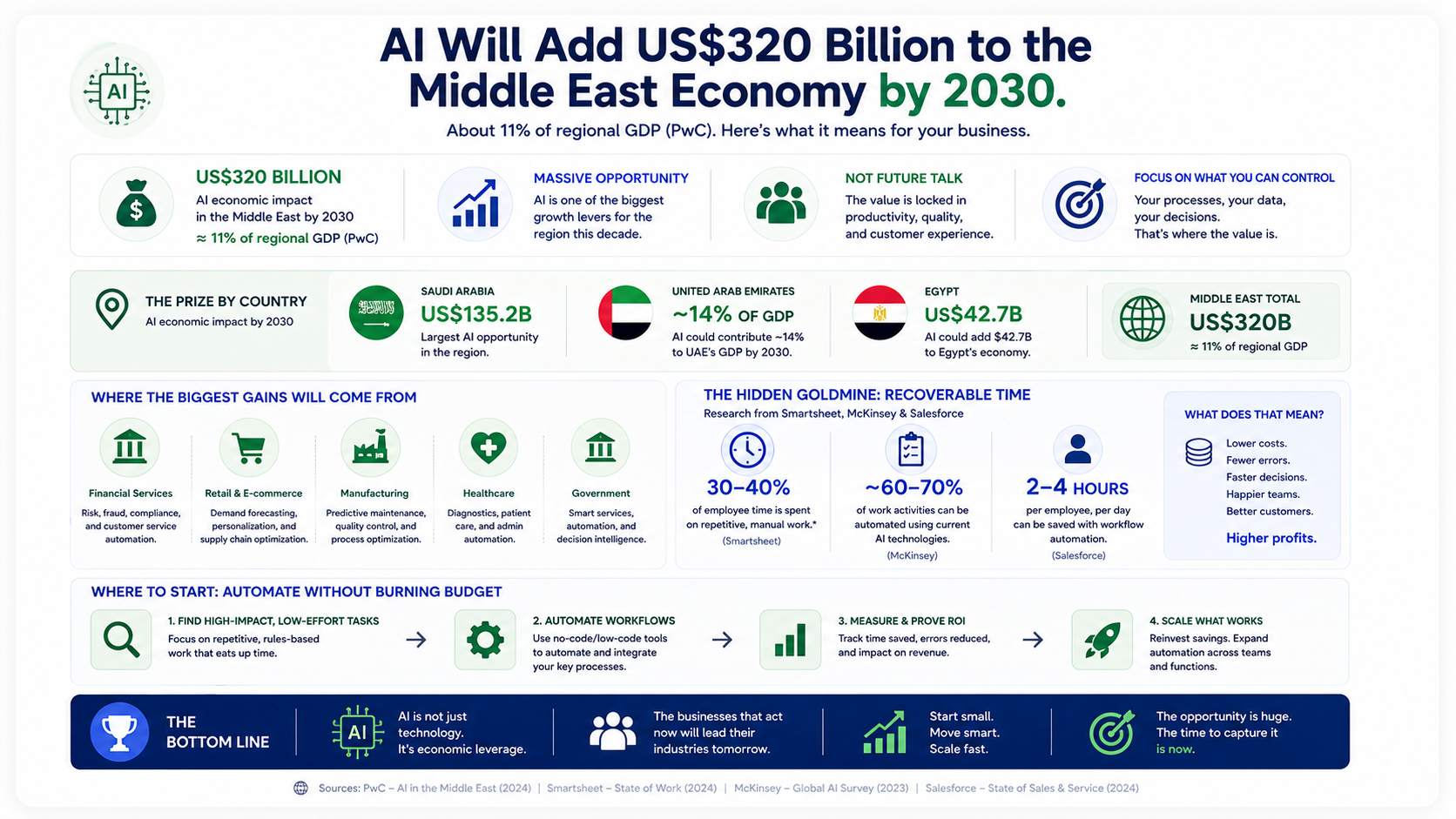
Consultancies keep repeating one number: AI will add US$320 billion to the Middle East economy by 2030 — about 11% of regional GDP (PwC). This research piece translates the macro forecasts into the units a business owner actually manages: hours, errors, and money. It breaks down the gains by country (Saudi Arabia $135.2B, UAE ~14% of GDP, Egypt $42.7B), identifies the winning sectors, and shows — with data from Smartsheet, McKinsey, and Salesforce — how much recoverable time is hiding inside a typical company's manual processes, and where to start automating without burning budget.
The challenge
Business owners across Egypt and the Gulf hear the AI headlines but can't connect them to their operations. Meanwhile, the research shows the cost of waiting is real: over 40% of office workers spend at least a quarter of their week on manual, repetitive tasks — data entry, copy-paste between systems, chasing approvals. For a 15-person company, that quietly equals close to two full-time salaries spent on work software should be doing. The macro forecasts feel abstract; the productivity leak is concrete, daily, and compounding — and competitors in the region's fastest-gaining sectors (manufacturing, construction, retail) are already moving.
Our approach
We translated the leading regional and global studies into an owner's playbook. First, the market reality: PwC's country-by-country and sector-by-sector projections showing where the $320B lands. Second, the operational reality: converging findings from Smartsheet, Automation Anywhere, McKinsey, and Salesforce on how many hours automation actually recovers (≈6 hours per employee per week). Third, three concrete automation patterns for regional businesses — quotation automation for trading companies, single-entry data flow for manufacturers, and bilingual AI on WhatsApp for services firms — all built on top of existing systems, not replacing them. The piece closes with a start-narrow methodology: map one process, automate the highest-touch workflow, measure for a month, then expand.
Ready to capture this advantage?
Book a free 30-minute strategy call and we'll map your fastest path to results.
Book a free strategy call